Grey-box model for reversible heat pumps using a black-box to
simulate the refrigeration cycle
Deprecation Warning
This model is deprecated, switch to the ModularReversible
approach. Read
https://github.com/RWTH-EBC/AixLib/wiki/Switch-from-model-HeatPump-to-ModularReversible
for further information.
Info
This generic grey-box heat pump model uses empirical data to
model the refrigerant cycle. The modelling of system inertias and
heat losses allow the simulation of transient states.
Resulting in the choosen model structure, several configurations
are possible:
- Compressor type: on/off or inverter controlled
- Reversible heat pump / only heating
- Source/Sink: Any combination of mediums is possible
- Generik: Losses and inertias can be switched on or off.
Concept
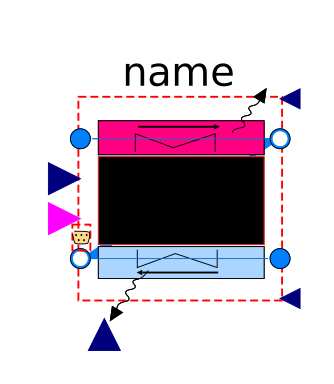
Using a signal bus as a connector, this heat pump model can be
easily combined with the new
HeatPumpSystem or several control or safety blocks from
AixLib.Controls.HeatPump.
The relevant data is aggregated. In order to control both chillers
and heat pumps, both flow and return temperature are aggregated.
The mode signal chooses the type of the heat pump operation. As a
result, this model can also be used as a chiller:
- mode = true: Heating
- mode = false: Chilling
To model both on/off and inverter controlled heat pumps, the
compressor speed is normalizd to a relative value between 0 and
1.
Possible icing of the evaporator is modelled with an input value
between 0 and 1.
The model structure is as follows. To understand each submodel,
please have a look at the corresponding model information:
- InnerCycle
(Black Box): Here, the user can use between several input models or
just easily create his own, modular black box model. Please look at
the model description for more info.
- Inertia: A n-order element is used to model system inertias
(mass and thermal) of components inside the refrigerant cycle
(compressor, pipes, expansion valve)
-
HeatExchanger: This new model also enable modelling of thermal
interias and heat losses in a heat exchanger. Please look at the
model description for more info.
Parametrization
To simplify the parametrization of the evaporator and condenser
volumes and nominal mass flows there exists an option of automatic
estimation based on the nominal usable heating power of the
HeatPump. This function uses a linear correlation of these
parameters, which was established from the linear regression of
more than 20 data sets of water-to-water heat pumps from different
manufacturers (e.g. Carrier, Trane, Lennox) ranging from about 25kW
to 1MW nominal power. The linear regressions with coefficients of
determination above 91% give a good approximation of these
parameters. Nevertheless, estimates for machines outside the given
range should be checked for plausibility during simulation.
Assumptions
Several assumptions where made in order to model the heat pump.
For a detailed description see the corresponding model.
-
Performance data 2D: In order to model inverter controlled heat
pumps, the compressor speed is scaled linearly
-
Performance data 2D: Reduced evaporator power as a result of
icing. The icing factor is multiplied with the evaporator
power.
- Inertia: The default value of the n-th order element is
set to 3. This follows comparisons with experimental data. Previous
heat pump models are using n = 1 as a default. However, it was
pointed out that a higher order element fits a real heat pump
better in.
- Scaling factor: A scaling facor is implemented for
scaling of the heat pump power and capacity. The factor scales the
parameters V, m_flow_nominal, C, GIns, GOut and dp_nominal. As a
result, the heat pump can supply more heat with the COP staying
nearly constant. However, one has to make sure that the supplied
pressure difference or mass flow is also scaled with this factor,
as the nominal values do not increase said mass flow.
Known Limitations
- The n-th order element has a big influence on computational
time. Reducing the order or disabling it completly will decrease
computational time.
- Reversing the mode: A normal 4-way-exchange valve suffers from
heat losses and irreversibilities due to switching from one mode to
another. Theses losses are not taken into account.
Contents
| Name |
Description |
 PerDataMainHP PerDataMainHP |
Performance data of a heat pump in main operation mode |
 PerDataRevHP PerDataRevHP |
Performance data of a heat pump in reversible operation
mode |
- May 22, 2019 by Julian Matthes:
Rebuild due to the introducion of the thermal machine partial model
(see issue #715)
- November 26, 2018 by Fabian Wüllhorst:
First implementation (see issue #577)
Generated at 2026-04-15T18:18:36Z by OpenModelicaOpenModelica 1.26.3 using
GenerateDoc.mos
 .AixLib.Obsolete.Year2024.Fluid.HeatPumps.HeatPump