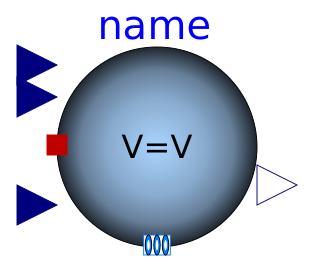
 .Annex60.Fluid.MixingVolumes.MixingVolumeMoistAir .Annex60.Fluid.MixingVolumes.MixingVolumeMoistAir
Model for an ideally mixed fluid volume and the ability to store mass and energy. The volume is fixed, and latent and sensible heat can be exchanged.
This model represents the same physics as Annex60.Fluid.MixingVolumes.MixingVolume,
but in addition, it allows adding or subtracting water in liquid
phase. The mass flow rate of the added or subtracted water is
specified at the port mWat_flow. The water flow rate
is assumed to be added or subtracted at the temperature of the
input port TWat. Adding water causes a change in
enthalpy and species concentration in the volume.
Note that this model can only be used with medium models that
include water as a substance. In particular, the medium model needs
to implement the function enthalpyOfLiquid(T) and the
integer variable Water that contains the index to the
water substance. For medium that do not provide this functionality,
use Annex60.Fluid.MixingVolumes.MixingVolume.
To increase the numerical robustness of the model, the constant
prescribedHeatFlowRate can be set by the user. This
constant only has an effect if the model has exactly two fluid
ports connected, and if it is used as a steady-state model. Use the
following settings:
prescribedHeatFlowRate=true if the only
means of heat transfer at the heatPort is a prescribed
heat flow rate that is not a function of the temperature
difference between the medium and an ambient temperature. Examples
include an ideal electrical heater, a pump that rejects heat into
the fluid stream, or a chiller that removes heat based on a
performance curve. If the heatPort is not connected,
then set prescribedHeatFlowRate=true as in this case,
heatPort.Q_flow=0.prescribedHeatFlowRate=false if there is heat
flow at the heatPort computed as K *
(T-heatPort.T), for some temperature T and some
conductance K, which may itself be a function of temperature
or mass flow rate.prescribedHeatFlowRate=false.The parameter mSenFac can be used to increase the
thermal mass of this model without increasing its volume. This way,
species concentrations are still calculated correctly even though
the thermal mass increases. The additional thermal mass is
calculated based on the density and the value of the function
HeatCapacityCp of the medium state
state_default.
This parameter can for instance be useful in a pipe model when the
developer wants to lump the pipe thermal mass to the fluid volume.
By default mSenFac = 1, hence the mass is unchanged.
For higher values of mSenFac, the mass will be scaled
proportionally.
Set the parameter use_C_flow = true to enable an
input connector for the trace substance flow rate. This allows to
directly add or subtract trace substances such as CO2 to the
volume. See Annex60.Fluid.Sensors.Examples.PPM
for an example.
sensibleOnly in
steBal as this constant is no longer used.s to allow this model to also
be used with Annex60.Media.Water.i_w to avoid a warning in
OpenModelica.Annex60.Fluid.MixingVolumes.BaseClasses.PartialMixingVolumeWaterPort.mXi_flow[Medium.nXi] to a scalar
input connector mWat_flow in the conservation equation
model. The reason is that mXi_flow does not allow to
compute the other components in mX_flow and therefore
leads to an ambiguous use of the model. By only requesting
mWat_flow, the mass balance and species balance can be
implemented correctly.cardinality
function. Therefore, all input signals must be connected.Annex60.Fluid.Interfaces.