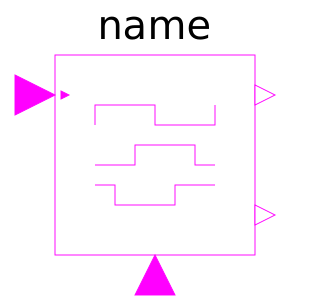
 .BLDC.Utilities.ElectronicCommutator3phase .BLDC.Utilities.ElectronicCommutator3phase
According to the Hall sensor signals uC[m=3], the
inactive (open) leg is choossen as well as the two legs that apply
the DC voltage to two terminals of the machine, and therefore let a
current flow through the corresponding phases of the machine to
obtain a current space phasor perpendicular to the rotor's magnetic
field. Of course due to the block commutation the angle between
rotor position and current space phasor varies in the range
[±90° - 30°, ±90° + 30°].
Setting the input pwm = true chooses the position
of the current space phasor as +90°, whereas setting
the input pwm = false results in a position of the
current space phasor as -90° w.r.t. the rotor
position. Applying a pwm signal (as for a brushed DC machine) to
the input pwm offers the possibility to set the mean
voltage applied to the phases choosen according to the Hall
signals.