 .BLDC.Utilities.HallTimeSpan .BLDC.Utilities.HallTimeSpan
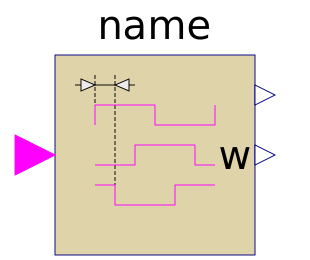
Evaluates the input signals from a HallSensor: a
180°-rectangle per phase (per pole pair) and determines electrical
angular velocity w and electrical angle
phi:
The time span from one edge of the input signals to the next is
measured, thus calculating the speed of rotation:
2*pi/(p*2*m)/(time - t0). Taking both rising and
falling edges into account, p*2*m edges per revolution
are observed. Note that the output is discrete w.r.t. to time, it
is not differentiable. The algorithm depends on interrupts (which
appear in Modelica as when-clauses). The direction of rotation has
to be detected by a logic from the sequence of the Hall signals.
Note that this algorithm depends on the accuracy of the
representation of time, but usually gives better results than
counting edges during a time gate.