Circadian Oscillator
This example is the modelica version of the model presented in
Modeling feedback loops of the Mammalian circadian
oscillator by Becker-Weimann S, Wolf J, Herzel H, Kramer A.
(Biophysical Journal Volume 87 November 2004 3023-3034)
Abstract
The suprachiasmatic nucleus governs daily variations of physiology
and behavior in mammals. Within single neurons, interlocked
transcriptional/translational feedback loops generate circadian
rhythms on the molecular level. We present a mathematical model
that reflects the essential features of the mammalian circadian
oscillator to characterize the differential roles of negative and
positive feedback loops. The oscillations that are obtained have a
24-h period and are robust toward parameter variations even when
the positive feedback is replaced by a constantly expressed
activator. This demonstrates the crucial role of the negative
feedback for rhythm generation. Moreover, it explains the rhythmic
phenotype of Rev-erbalpha-/- mutant mice, where a positive feedback
is missing. The interplay of negative and positive feedback reveals
a complex dynamics. In particular, the model explains the
unexpected rescue of circadian oscillations in Per2Brdm1/Cry2-/-
double-mutant mice (Per2Brdm1 single-mutant mice are arrhythmic).
Here, a decrease of positive feedback strength associated with
mutating the Per2 gene is compensated by the Cry2-/- mutation that
simultaneously decreases the negative feedback strength. Finally,
this model leads us to a testable prediction of a molecular and
behavioral phenotype: circadian oscillations should be rescued when
arrhythmic Per2Brdm1 mutant mice are crossed with Rev- erbalpha -/-
mutant mice.
Simulations
The simulation results are shown in the Figure
1. This plot corresponds to Fig 3A from the paper
(Becker-Weimann, 2004). 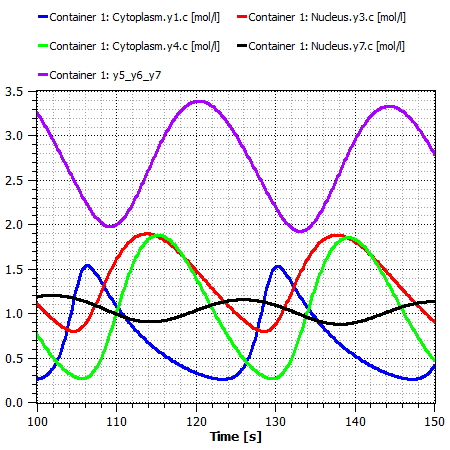
Generated at 2026-04-15T18:18:36Z by OpenModelicaOpenModelica 1.26.3 using
GenerateDoc.mos
 .BioChem.Examples.CircadianOscillator.Container