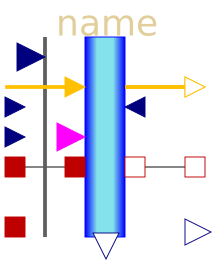
 .BuildSysPro.Building.BuildingEnvelope.HeatTransfer.DoubleGlazingWindow .BuildSysPro.Building.BuildingEnvelope.HeatTransfer.DoubleGlazingWindow
Double glazing model based on the
Window model but with simplified settings
including the characterization of glazing properties according to
the three following parameters:
 (energy transmission of solar energy)
Hypothesis and equation
As for the generic glass model:
GLOext=True in advanced
parameters) and by specifying the surface tilt.Regarding the rolling shutters, the assumptions are:
When the window is open, there is "broke" of the conductance
through the glass, and instead of that a debit of air renewal by
natural ventilation is computed (refer to
WindowNaturalVentilation).
Reduction coefficients of direct and diffuse fluxes may also be
considered (if useReduction=True), based on:
FLUXsurfMask)In addition, it is assumed that:
U is given by the
manufacturer for heEN673 = 25 W / m²K and
hi = 7.7 W / m²K (standard EN673)heEN410 = 23 W/m².K et hi = 7,7 W/m².K
(standard EN673) ,
,  et
et  )
)The Window model needs to know the surface transmission
coefficient k of the glazing and coefficients of
transmission and direct and diffuse absorption (TRDIR,
TrDif, AbsDir and
AbsDif).
k is defined directly depending on U
according to the standard EN673:  where
where he = 25 and
hi = 7.7 W/m².K
Then, knowing that  , where
 qi is the factor of
thermal retransmission towards the inside of the glazing.
And that  where
where
he = 23 and hi =7.7 W/m².K (standard
EN410). The direct absorption coefficient of the solar energy
outside of the glass is considered identical to the one inside.
The glass absorption coefficient is: 
Coefficients of absorption and transmission by double glazing
( et ) of the direct radiation at normal incidence are
then determined considering the laws of reflection and transmission
in a double glazing with , and glass properties
et ) of the direct radiation at normal incidence are
then determined considering the laws of reflection and transmission
in a double glazing with , and glass properties


Knowing and , is deduced after resolution of the above equations
system.

The coefficient of direct radiation is deduced:


Note: these coefficients are then the ones used in the block
DirectTrans that uses a correlation to determine
these coefficients as a function of the angle of incidence. Then
the weighting used is the one specified in the RT (French building
regulation).
Then Cadiergues relations are used for the diffuse radiation


Concerning the calculation of natural lighting, global and
diffuse light transmission factors that must be filled correspond
to TLW, TLw_dif, TLsw and
TLsw_dif which are calculated precisely in the EN 410
standard. However, it is possible to find tabulated values in the
document Valeurs tabulées des caractéristiques des parois
vitrées et des correctifs associés aux baies (Tabulated values of
glass walls features and patches associated with windows) from
CSTB. Thus, by default:
TLW = 0.5,
TLW dif = 0TLsw = 0, TLsw_dif = 0TLsw = 0.09, TLsw_dif =
0.03Bibliography
Normes EN410 et EN673
R. Cadiergues, 1978, L'absorption du rayonnement par les vitrages et son calcul. 1-Les vitrages non réfléchissants, Promoclim E, Etudes Thermique et Aérauliques, Tome 9 E, n°1
R. Cadiergues, 1978, Un mode simple de calcul des flux à travers les vitrages. 1-Les vitrages non traités, Promoclim E, Etudes Thermique et Aérauliques, Tome 9 E, n°1
Eclairement naturel : Règles Th-L - Caractérisation du facteur de transmission lumineuse des parois du bâtiment - CSTB Mars 2012, Valeurs tabulées des parois vitrées - CSTB Mars 2012
Instructions for use
The thermal ports T_ext and T_int must
be connected to temperature nodes (connect T_ext to
T_dry of
Meteofile).
The external incident flows FLUX can come from the
BoundaryConditions.Solar
models which are the link between walls and weather readers.
The internal incident flows FluxAbsInt can come
from occupants, heating systems but also from the redistribution of
solar flux within a room (models from BoundaryConditions.Radiation).
Known limits / Use precautions
The following precautions should be considered:
should not be confused with the coefficient
TL which is light transmission often given by
manufacturersFor the calculation of illuminance, it is needed to clarify whether there are upstream masks because then the consideration of shadows caused by the architecture is done in the mask model.
Validations
Model validated by verifying that the coefficients of absorption and transmission of direct and diffuse radiation as well as the input conductivities of Window model were well consistent with those determined via an Excel sheet based on the formulas of the standards used.
Validated model - Aurélie Kaemmerlen 05/2011
--------------------------------------------------------------
Licensed by EDF under a 3-clause BSD-license
Copyright © EDF 2009 - 2023
BuildSysPro version 3.6.0
Author : Aurélie KAEMMERLEN, EDF (2011)
--------------------------------------------------------------
Gilles Plessis 06/2011 :
Aurélie Kaemmerlen 10/2011 : Ajout des échanges avec l'environnement (ciel et sol)
Amy Lindsay 03/2014 : - ajout de la possibilité de commander un
volet (fermeture_volet qui varie entre 0 et 1 - 1 quand le volet
est fermé, 0 quand le volet est ouvert), avec la résistance
thermique supplémentaire que cela engendre.
- ajout de la possibilité d'ouvrir la fenêtre (true quand la fenêtre est ouverte, false quand elle est fermée) avec le débit de ventilation naturelle que cela engendre
- ajout des coefficients de réduction des flux diffus/direct en fonction du type de fenêtre / porte fenêtre, de la présence de voilages, rideaux etc. issus des stages de Raphaelle Mrejen (2012) et Alexandre Hautefeuille (2013)
- changement des FluxSolInput en RealInput pour les flux absorbés intérieur pour éviter les confusions (ces flux absorbés en GLO ou en CLO peuvent non seulement provenir du soleil, mais aussi d'autres sources radiative)
Laura Sudries, Vincent Magnaudeix 05/2015 : Prise en compte des flux lumineux incidents sur la baie pour calculer les flux lumineux transmis à travers la baie considérée (direct, diffus, réfléchi par le sol) et l'éclairement total incident sur la baie. Equations issues de la RT2012.
Gilles Plessis 07/2015 : Homogénéisation des paramètres avec
ceux du modèle Window.