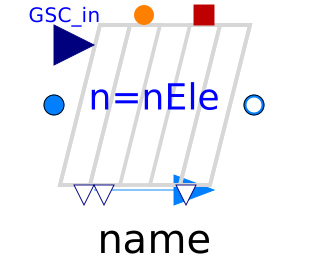
 .BuildingSystems.Technologies.SolarThermal.ThermalCollector .BuildingSystems.Technologies.SolarThermal.ThermalCollector
This model is a general solar thermal collector.
Calculation of the total incident solar radiation, Itot, is defined as follows.
Itot = Idir *(1-GSC)*IAM+Idif
where Idir and Idif are the total direct and diffuse irradiation on the absorption surface in W/m2 respectively. GSC is the geometrical shading coefficient for the direct irradiation and IAM the incidence angle modifier.
Calculation of incidence angle modifier,
IAM = 1 + (IAMC-1)/0.5557*(1/cos(θ)-1)
where θ is the angle between the normal to the collector surface
and the incident irradiation. IAMC is the incidence angle modifier
evaluated at θ=50 deg.
nEle. The use of the preset value of 10 nodes pro
solar thermal collector is recommended.
angleDegAzi and angleDegTil. The
parameters are used by external models such as
radiation.
C_0, C_1 and C_2 are
referenced to the absoerber area. In case of flat plate collectors
this is the total exposed are of the solar absorber and for
evacuated tube collectors, the diameter of the round absorber, or
flat area of the absorber for evacuated tubes with absorber fins
inside.
The heat capacity of the solid part of the collector can be lumped into the volume heat capacity via defining a heat capacity per square meter of absorber area.
It is possible to take into account the shadings on the solar
panels via the use of the geometrical shading coefficient
GSC. For that purpose it is necessary to set to true
the parameter use_GSC_in found in the advanced tab.
The GSC stands for the ratio between shaded and total
receiver plane area, its value should be thus between 0 and 1.
Notice that the GSC factor is applied just to the direct
irradiation but not to the diffuse portion.
A single incidence angle modifier, IAM, for direct radiation is calculated. Furthermore the model does not distinguish between transverse and logitudional IAM. This assumption is valid for flat solar thermal collectors but innapropiaite for evacuated tub collectors, ETC, and concentrating solar panels,CPC. For those type of collectors the incidence angle modifier should be evaluated for more than one direction (longitudinal and transversal) and at different angles (20 deg, 40 deg, ...).
The efficiency of the collector does not take into account explicitly the wind speed.