 .BusinessSimulation.CausalLoop.PipelineDelay .BusinessSimulation.CausalLoop.PipelineDelay
This information is part of the Business Simulation Library (BSL). Please support this work and ► donate.
The →PureDelay
is used to model a pipeline delay. The aggregate nature of
causal loop modeling requires to make a clear distinction between
delaying an inflow as opposed to an outflow to
the stock connected to the flowPort: A delayed inflow
will reach the stock with a delay, while a delayed outflow
will leave the stock with a delay.
While modeling a delayed inflow is uncontroversial, modeling a
delayed outflow imposes choices: Setting
subtractDelayedOutflow = true will report the current
amount in the stock less the amount that is in the process of being
delayed at the stockPort. Accordingly, a process of
exponential decay will not drain the stock below zero.
If this is not wanted, setting subtractDelayedOutflow =
false will report the actual stock level, i.e., any material
that has not yet left the stock will be considered a still
active member of the stock in the process . Accordingly, a
delayed process of exponential decay could drain the stock below
zero.
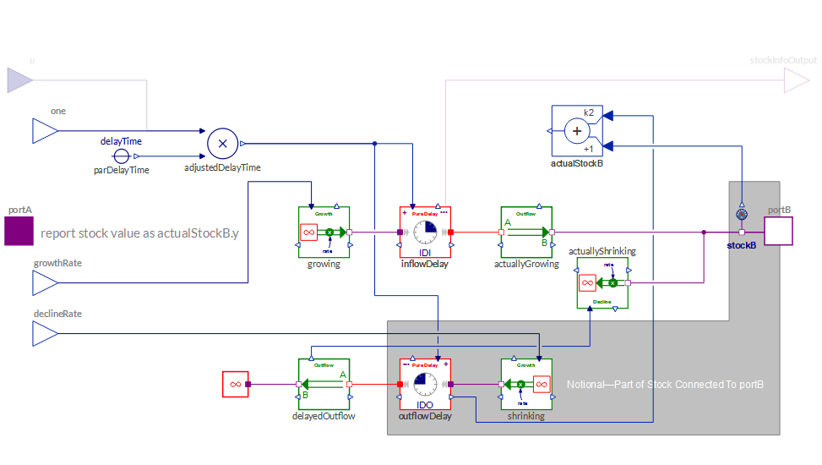 |
stockPort. Other flows connected to
the stock, that is connected to the stockPort of the
component will see the stock value without any "premature"
deductions, i.e., material will only be deducted from the stock
once it as truly left the stock.MaterialStock
cannot be drained below zero.inflowDelay and outflowDelay are by
default initialized with zero elements in the process of flowing
into and out of the connected stock. This can be changed by
changing the values for the parameters IDO and
IDI in the Initialization tab.