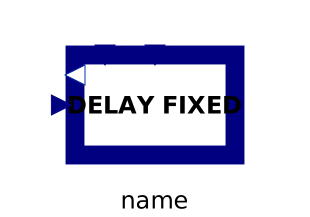
 .BusinessSimulation.Converters.DiscreteDelay.DelayFixed .BusinessSimulation.Converters.DiscreteDelay.DelayFixed
This information is part of the Business Simulation Library (BSL). Please support this work and ► donate.
The real output y is the real input
u delayed by a fixed delay time
which can be constant (delayTime) or variable
(u_delayTime) during the simulation.
y[t] = u[t - delayTime]
The input signal is thus effectively shifted forward in time.
During an initial period (at most as long as the initial
delayTime or the maximumDelayTime when
the delay time can vary over time), we need to provide
information about the historical input u (e.g.,
the input before the start time of the simulation). The
historical input can either be given by a
constant value (either the initialValue
or the initial input u) or by a function of
time (usually a TableFunction),
that will take the output connector y_lookupTime
as input and then provide the relevant historical input via
the input connector u_history.
DelayInformation and
DelayFixed are quite similiar, but there is a subtle
difference:DelayInformation models the delay in perceiving
information where the recipient is aware of the delay time and
thus will disregard
informatiion that is older than the one he already
has.DelayFixed we will strictly delay any
information given the actual delay time at any point in time and
thus may receive information that is actually older than previous
information when the delay time increases.DelayFixed is an information
delay, that is used to model delays in updating beliefs
and perceptions; unlike a material delay matter is not conserved
[20]. init in the Advanced tab allows to
select →InitializationOptions:initialValue to determine the initial output
y.initialValue as an initial guess.DelayInformation, Smooth, SmoothN, Conveyor