 .BusinessSimulation.Examples.LotkaVolterraSystems .BusinessSimulation.Examples.LotkaVolterraSystems
This information is part of the Business Simulation Library (BSL). Please support this work and ► donate.
This is the basic two species model of predation from ecology—the so called Lotka-Volterra-Model [17].
In the upper model we recognize more explicitly that both
populations, rabbits and foxes, have independent processes of
exponential growth (the prey population's net rate of
growth) and exponential decline (the predator's net rate
of negative growth when there is no prey). The predation is
modeled using an an →interaction
(a special kind of flow element). It introduces nonlinearity, as
there is some fractional rate (beta, delta) that is
multiplied with rabbits(t) ⋅ foxes(t). Predation
results in an outflow from the rabbit population (increased deaths)
and an inflow to the prey population (increased reproduction).
The model below shows the same model structure in a generalized, more compact fashion using the interaction flow component →LotkaVolterra .
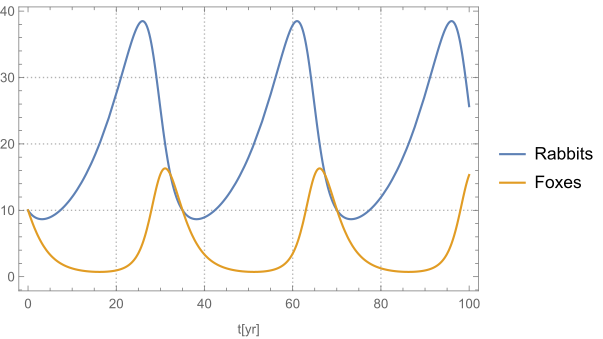 |
0.1
[1/yr]
using the displayUnit attribute and
conversion tables. All calculations in a simulation will always use
SI-units for time so that rates are in unit 1/s and
times in unit s.modelOutput) where the variables
rabbits, foxes, prey, predators are explicitly
declared with appropriate units.The model presented here comes from Michael Tiller's excellent introduction "Modelica by Example" (see Describing Behavior>Basic Equations>Examples>Lotka-Volterra System), which ships with SystemModeler and can also be found online.
LotkaVolterra, NonlinearInteraction, ExponentialGrowth, ExponentialDecline
| Name | Description |
|---|---|
 Theta Theta |
Parameter definitions for the Base Case |
 ModelOutput ModelOutput |
foxes does not
need unit="foxes", diagram and simulation plots in
v2.0.0.