 .BusinessSimulation.SourcesOrSinks.LogisticGrowth .BusinessSimulation.SourcesOrSinks.LogisticGrowth
This information is part of the Business Simulation Library (BSL). Please support this work and ► donate.
LogisticGrowth describes the growth of some population
that is limited by the availability of some finite resource. While
the population starts to grow exponentially at first at a given
fractional rate of growth (either given by the constant parameter
r or by the time-variant input u[1]), its
growth rate will continously diminish until the population reaches
its sustainable level (either given by the constant parameter
K or the time-variant input u[2]), which
is called the carrying capacity.
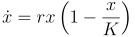
The rate of inflow to a connected stock is given by the so called Verhulst equation:
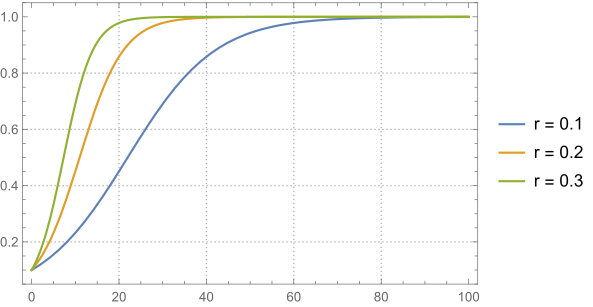
The diagram below shows the s-shaped growth for a population x for different rates of growth:
 |
isCCR = true). If this is not case,
the rate will be converted using the →ForceOfInterest
converter.K < x the inflow to the stock can become
negative. This is allowed and the modeler has to take care that the
input or parameter values make sense for the process being
modeled.The logistic growth equation is originally due to the Belgian mathematican Pierre-François Verhulst (1804 - 1849).
| Name | Description |
|---|---|
 CapacityType CapacityType |
Type for carrying capacity K |
K and defaulted optional
constant parameters to unspecified.