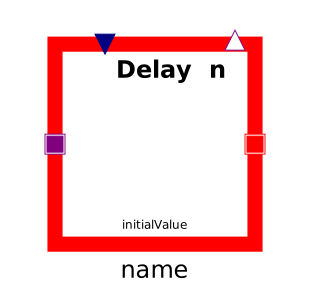
 .BusinessSimulation.Stocks.DelayN .BusinessSimulation.Stocks.DelayN
This information is part of the Business Simulation Library (BSL). Please support this work and ► donate.
The DelayN is a →MaterialStock with
inherent dynamic behavior that will result in a
delay—which may have a constant (delayTime)
or a variable delay time (u). Internally a
material delay of order n is made up of a sequence of
n first-order delays (→Decay
) each having a delay time of delayTime/n.
To better grasp the behavior of a DelayN, it helps to
be aware of the fact, that given a single pulse input (e.g., a
Dirac delta function) as inflow to a DelayN with constant
delay time, its outflow will correspond to an
Exponential distribution for n = 1 and more
generally to an Erlang distribution of order k =
n for n ≥ 1. In other words, the time of
residence within the stock is distributed according to an
Erlang distribution with the mean residence time corresponding to
the delay time and a diminishing variance as n
increases—in the limit, as n approaches infinity, the
DelayN will be equivalent to the →PureDelay (aka
pipeline delay). For more detail, see Sterman [3,
Chapter 11].
inflow stock port.init in the Advanced tab allows to
select →InitializationOptions:initialValue to determine the initial value for all
n hidden states as initialValue/n.inflow.rate * delayTime / nstartValue.MaterialStock, PureDelay, Converters.DiscreteDelay