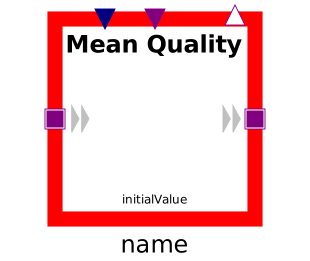
 .BusinessSimulation.Stocks.HinesCoflow .BusinessSimulation.Stocks.HinesCoflow
This information is part of the Business Simulation Library (BSL). Please support this work and ► donate.
The HinesCoflow is a modification of the classical
coflow structure used in system dynamics [6, pp.
50f.]. The traditional coflow is a model of a stock's average
quality (e.g., age, weight, price, income etc.) changing, as new
entities with different characteristics
u flow in while older entities flow
out—in which case we assume, that the outflowing entities have an
average quality [3, pp.
497-511].
The HinesCoflow makes use of the fact, that the average quality of the entities in the stock is diluted by inflowing entities of different quality, i.e., the process is a smooth with a variable time constant. The benefit of this formulation is, that the average quality of the stock is directly modeled by a stock, so that processes that change the average (e.g., gaining experience over the time of residence for a stock of workers) can be directly modeled as in- or outflows to the HinesCoflow.
StockInfoInput connector to collect the required
information from a connected stock. For this to properly work out,
inflows and outflows should not be mixed at a single
StockPort (e.g., it is best practice to connect known
inflows to the inflow and known outflows to the
outflow port). In case of a bi-directional flow, only
one bi-flow should be connected to any single
StockPort—no additional flows should be present at
that port (see notes for →AbsoluteSensor).StockInfoOutput
(y_stockInfo) can be used to pass the stock
information received from a connected stock onward to additional
coflow components—or sensors.The Hines Coflow is explicitly named after its creator, James Hines. More information can be found on his website.