 .BusinessSimulation.Stocks.Oven .BusinessSimulation.Stocks.Oven
This information is part of the Business Simulation Library (BSL). Please support this work and ► donate.
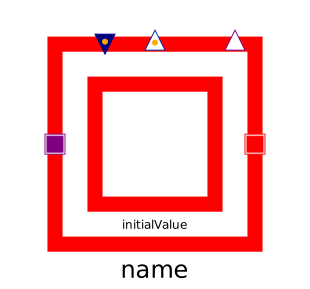
An oven (aka batch delay) can be seen as an idealized model of a batch process, e.g., cookies are put on a baking tray, the oven is loaded, the cookies are baked for some time, and finally the oven is unloaded (the process may then start over again).
The parameters or inputs batchSize,
maxLoadingTime, processingTime, and
setupTime specify the behavior of the batch process.
The oven is loaded by a flow connected to its inflow
port (usually from a cloud or another stock representing a buffer
stock) until either the batchSize is reached (the
oven's capacity) or the time since the loading of the oven
commenced has reached the maxLoadingTime. It will then
close and prevent further inflow for the duration of the
processingTime. The unloading of the finished
"material" will take place in dt time - a global
variable that indicates the shortest possible durationa of any
process in a model. The reloading can commence after
setupTime has passed since the process has ended. For
setupTime = 0 simulatenous loading and unloading will
take place.
To initialize the oven, an initialLoad and an
initialLoadingTime (e.g., how much time has already
passed loading the oven when the simulation starts) have to be
given.
batchSize, maxLoadingTime,
processingTime, and setupTime can be
time-varying continuous inputs, but are internally recalculated
every time the process starts and then are held fixed.| Name | Description |
|---|---|
 InputConnector InputConnector |
Named inputs for the component |
 OutputConnector OutputConnector |
dataIn in v2.1.0.InputConnector and
OutputConnector changed to encapsulated
expandable connector classes in v2.1.0.unspecified in v.2.1.0.