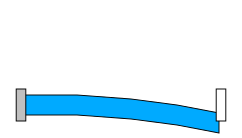
 .DeployStructLib.Parts.Beam .DeployStructLib.Parts.Beam
Standard beam model for DS Library. This block can be used to model either rigid or flexible beams, by setting the value of the "rigid" flag to either true or false.
The length of the beam should be set here in the beam block. Cross-sectional dimensions and cross section type should be passed in via one of the DeployStructLib.Properties.BeamXProperties records. Material properties should similarly be supplied by an DeployStructLib.Properties.MaterialProperties record.
For rigid beams only: If parameter useQuaternions
is true (this is the default), then 4 quaternions are
potential states. Additionally, the coordinates of the absolute
angular velocity vector of the body are 3 potential states.
If useQuaternions in the "Advanced" menu is false,
then 3 angles and the derivatives of these angles are
potential states. The orientation of frame_a is computed by
rotating the world frame along the axes defined in parameter vector
"sequence_angleStates" (default = {1,2,3}, i.e., the Cardan angle
sequence) around the angles used as potential states. For example,
the default is to rotate the x-axis of the world frame around
angles[1], the new y-axis around angles[2] and the new z-axis
around angles[3], arriving at frame_a.
The quaternions have the slight disadvantage that there is a non-linear constraint equation between the 4 quaternions. Therefore, at least one non-linear equation has to be solved during simulation. A tool might, however, analytically solve this simple constraint equation. Using the 3 angles as states has the disadvantage that there is a singular configuration in which a division by zero will occur. If it is possible to determine in advance for an application class that this singular configuration is outside of the operating region, the 3 angles might be used as potential states by setting useQuaternions = false.
Copyright © 2018
ATA ENGINEERING, INC.
ALL RIGHTS RESERVED