x = a + b ecx
where b and c must be nonzero. The solution is found via the
Lambert W functions:
x = a - W(-bc eac) / c
where W(y) is a solution of: W(y) eW(y) = y .
If the argument (y = -bc eac) of the W function is
real and between -1/e and 0, then there are two real W values:
W0 (> -1) and W-1 (<
-1).
If the argument is real and >=0, then there is one real
value: W0.
The boolean outputs bx[1] and bx[2] denote whether real
solutions for x exist. If their values are "true", then the
corresponding x values contain the solutions: x[1] from
W0 and x[2] from W-1.
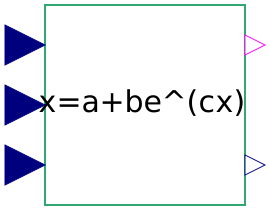 .GNU_ScientificLibrary.Blocks.specfunc.NumericalInversions.SolveExpTranscend