Electron Degeneracy Pressure
Model for calculating the contribution to the equation of state
(EoS) which arises from the main exchange interaction (degeneracy)
between electrons in a plasma (or conduction electrons in a metal).
At extremely high densities (white dwarf), this becomes the
dominant interaction.
For the complete EoS, electromagnetic interactions (direct and
exchange) among the electrons and ions must also be taken into
account (see, e.g., §§ 78-80 in Landau and Lifshitz, Statistical
Physics Part 1 (3rd edition), 1980).
[See also the 'integration.DoubleFDIntegrals' example
herein.]
Note the use of the 'FermiDirac_InvertFhalf' block for
numerically determining x from F1/2(x)-y=0, essentially
obtaining the chemical potential, mu=x*k*T, from the number density
(~ F1/2(x)*T3/2) and temperature (T). x is
then used to find the pressure from F3/2(x) and T (p ~
F3/2(x)*T5/2).
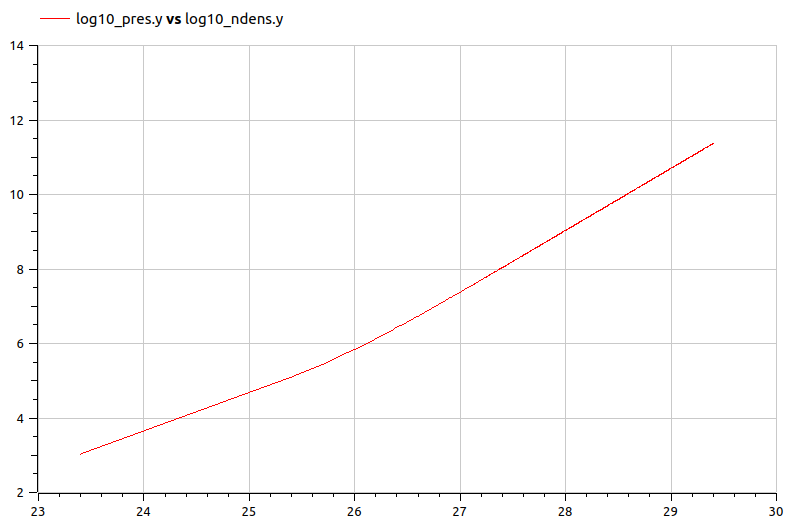
A parametric plot of 'log10_pres.y' (in log10 Pa) vs
'log10_ndens.y' (in log10 m-3) should impress upon one
the phenomenal pressures exerted by fermions' inability to occupy
the same quantum states, and the tremendous forces (internal or
external) at play for these to be counteracted in materials (EM in
solids, gravity in stars). At lower densities, this plot reveals a
slope of about 1 (or P ~ n; Maxwell-Boltzmann gas), while at higher
densities, the slope tends toward 5/3 (P ~ n5/3;
degenerate gas; EoS becomes stiffer). If one considers Cu, with
8.43*1028 conduction-e/m3, at T=300K,
this is well in the degenerate region (x=270), with P =
38 GPa ! (It is not encoded herein, but at extremely high
densities, mu > me*c2, relativistic
effects become important and the EoS should turn over to P ~
n4/3.)
Generated at 2026-04-15T18:18:36Z by OpenModelicaOpenModelica 1.26.3 using
GenerateDoc.mos
 .GNU_ScientificLibrary.Examples.specfunc.ElectronDegPres