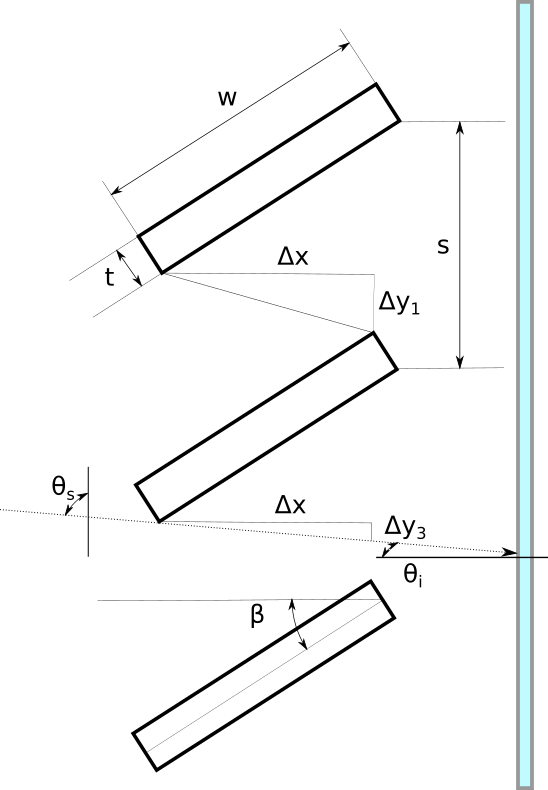
Shading model for exterior horizontal fins in front of a window,
in function of the fin angle. The control input Ctrl
can either be used for controlling the fin angle, or its horizontal
displacement. The horizontal displacement option assumes that the
fins can be displaced horizontally at the exterior of the window
such that they are either in front or next to the window.
We assume that the fins fully cover the window unless the
horizontal displacement option is used. The fin angle
beta should be positive. We compute the shaded
fraction of the direct solar irradiation and assume that indirect
reflect effects are negligible. The diffuse solar irradiation is
correct by assuming that the diffuse solar irradation originates
from a solar altitude angle of 30 degrees, which is an
approximation to reality. The ground diffuse solar irradation is
not modified.
Parameter t is the fin thickness, s is
the vertical spacing between the fins and w is the fin
width. The model assumes that s <= w. If
use_betaInput=true, the input Ctrl is
used to control the angle beta in the figure, such that Ctrl
= 0 corresponds to beta = 0 and Ctrl =
1 corresponds to beta = acos(t/s), which is the
maximum value for beta. Note that beta
must have radians as a unit. If
use_displacementInput=true, the input 0 <
Ctrl < 1 is used to control the horizontal displacement
of the fins. For Ctrl=0, the fins are moved away from
the window, into the plane of the figure below, such that no sun
light is blocked. Either use_displacementInput or
use_betaInput should be false. See the figure below
for an illustration.
This model has no dynamics.
The implementation is illustrated using this figure:
Ctrl_to_beta_internal=0 when not using beta
input. Otherwise the variable is undefined, resulting in a singular
system. See #1426.Ctrl_to_beta_internal to linearly map the Ctrl
input [0,1] onto the fin inclination angle
[0,beta_max].dispLim as disp_internal is
automatically in the range [0,1] due to the definition of
Ctrl.