This is a single zone residential hydronic system model for WP 1.2 of IBPSA project 1.
This building envelope model corresponds to the BESTEST case 900 test case. It consists of a single zone with a rectangular floor plan of 6 by 8 meters and a height of 2.7 m. The zone further consists of two south-oriented windows of 6 m2 each, which are modelled using a single window of 12 m2.
The walls consist of 10 cm thick concrete blocks and 6 cm of foam insulation. For more details see IDEAS.Buildings.Validation.Data.Constructions.HeavyWall. The floor consists of 8 cm of concrete and 1 m of insulation, representing a perfectly insulated floor. The roof consists of a light construction and 11 cm of fibreglass.
The zone is occupied by one person before 7 am and after 8 pm each weekday and full time during weekends.
There are no internal loads other than the occupants.
The model uses a climate file containing one year of weather data for Brussels, Belgium.
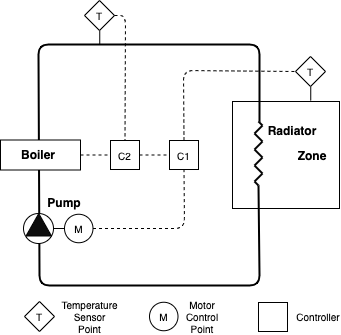
The model only has a primary heating system that heats the zone using a single radiator with thermostatic valve, a circulation pump and a water heater. The system is presented in Figure 1 below. The radiator nominal thermal power and heater maximum thermal power is 5 kW. The heating setpoint is set to 21 °C during occupied periods and 15 °C during unoccupied periods. The cooling setpoint is set to 24 °C during occupied peridos and 30 °C during unoccupied periods. The gas heater efficiency is computed using a polynomial curve and it uses a PI controller to modulate supply water temperature between 20 and 80 °C to track a reference for the operative zone temperature that equals the heating setpoint plus an offset of 0.1 °C by default.
The heating system circulation pump has the default efficiency of the pump model, which is 49%; at the time of writing. The heater efficiency is computed using a polynomial curve.
The model assumes a pump with a constant head, which results in a fixed flow rate due to the fixed pressure drop coefficient of the radiator. The supply water temperature set point of the boiler is modulated using a PI controller that tracks zone operative temperature to follow the zone operative temperature setpoint, depicted as controller C1 in Figure 1 and shown in Figure 2 below. For baseline control, this setpoint is defined as the heating comfort setpoint plus an offset of 0.1 °C. The pump is switched on and off with hysteresis based on the indoor temperature with the heating set point as the low point and the cooling set point as the high point. It is assumed that the boiler exactly outputs the supply water temperature set point using an ideal controller depicted as C2 in Figure 1.
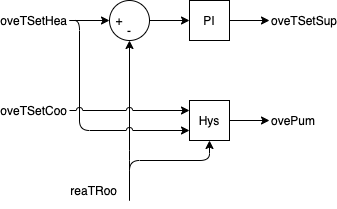
The model inputs are:
oveTSetHea_u [K] [min=288.15, max=296.15]: Zone
operative temperature setpoint for heatingoveTSetCoo_u [K] [min=296.15, max=303.15]: Zone
operative temperature setpoint for coolingoveTSetSup_u [K] [min=293.15, max=353.15]: Supply
temperature setpoint of the heaterovePum_u [1] [min=0.0, max=1.0]: Integer signal to
control the stage of the pump either on or offThe model outputs are:
reaQHea_y [W] [min=None, max=None]: Heating
thermal powerreaPPum_y [W] [min=None, max=None]: Pump
electrical powerreaCO2RooAir_y [ppm] [min=None, max=None]: CO2
concentration in the zonereaTRoo_y [K] [min=None, max=None]: Operative zone
temperatureweaSta_reaWeaPAtm_y [Pa] [min=None, max=None]:
Atmospheric pressure measurementweaSta_reaWeaHGloHor_y [W/m2] [min=None,
max=None]: Global horizontal solar irradiation measurementweaSta_reaWeaNOpa_y [1] [min=None, max=None]:
Opaque sky cover measurementweaSta_reaWeaTBlaSky_y [K] [min=None, max=None]:
Black-body sky temperature measurementweaSta_reaWeaNTot_y [1] [min=None, max=None]: Sky
cover measurementweaSta_reaWeaSolAlt_y [rad] [min=None, max=None]:
Solar altitude angle measurementweaSta_reaWeaSolZen_y [rad] [min=None, max=None]:
Solar zenith angle measurementweaSta_reaWeaHHorIR_y [W/m2] [min=None, max=None]:
Horizontal infrared irradiation measurementweaSta_reaWeaSolTim_y [s] [min=None, max=None]:
Solar timeweaSta_reaWeaCloTim_y [s] [min=None, max=None]:
Day number with units of secondsweaSta_reaWeaLon_y [rad] [min=None, max=None]:
Longitude of the locationweaSta_reaWeaRelHum_y [1] [min=None, max=None]:
Outside relative humidity measurementweaSta_reaWeaSolDec_y [rad] [min=None, max=None]:
Solar declination angle measurementweaSta_reaWeaHDirNor_y [W/m2] [min=None,
max=None]: Direct normal radiation measurementweaSta_reaWeaWinDir_y [rad] [min=None, max=None]:
Wind direction measurementweaSta_reaWeaTWetBul_y [K] [min=None, max=None]:
Wet bulb temperature measurementweaSta_reaWeaTDewPoi_y [K] [min=None, max=None]:
Dew point temperature measurementweaSta_reaWeaWinSpe_y [m/s] [min=None, max=None]:
Wind speed measurementweaSta_reaWeaHDifHor_y [W/m2] [min=None,
max=None]: Horizontal diffuse solar radiation measurementweaSta_reaWeaLat_y [rad] [min=None, max=None]:
Latitude of the locationweaSta_reaWeaTDryBul_y [K] [min=None, max=None]:
Outside drybulb temperature measurementweaSta_reaWeaCeiHei_y [m] [min=None, max=None]:
Cloud cover ceiling height measurementweaSta_reaWeaSolHouAng_y [rad] [min=None,
max=None]: Solar hour angle measurementNo lighting model is included.
No shading model is included.
The model uses moist air despite that no condensation is modelled in any of the used components.
A simple, single circulation loop is used to model the heating system.
Fixed air infiltration corresponding to an n50 value of 10 is modelled.
The Peak Heat Day (specifier for /scenario
API is 'peak_heat_day') period is:
The Typical Heat Day (specifier for
/scenario API is 'typical_heat_day')
period is:
All pricing scenarios include the same constant value for transmission fees and taxes of each commodity. The used value is the typical price that household users pay for the network, taxes and levies, as calculateed by Eurostat and obtained from: "The energy prices and costs in Europe report". For the assumed location of the test case, this value is of 0.20 EUR/kWh for electricity and of 0.03 EUR/kWh for gas.
The Constant Electricity Price (specifier for
/scenario API is 'constant') profile
is:
The Dynamic Electricity Price (specifier for
/scenario API is 'dynamic') profile
is:
The Highly Dynamic Electricity Price (specifier for
/scenario API is 'highly_dynamic')
profile is:
The Electricity Emissions Factor profile is:
The Gas Emissions Factor profile is:
| Name | Description |
|---|---|
| MediumWater | Water medium |
| MediumAir | Air medium |