This first example instantiates a simple building model that consists of one zone, four walls, a window, a floor and a ceiling. The zone dimensions are 8 m (with walls oriented north and south) by 4 m, and the window measures 3 m by 1.4 m. Use the default zone height of 2.8 m. Apply double glazing and a heavy wall, which provide high thermal mass.
Each yellow bus connector of a surface (Window,
OuterWall or SlabOnGround) has to be
connected to exactly one zone bus connector. To support multiple
connections, the zone has an array of bus connectors with size
nSurf, where nSurf is a parameter of
Zone, which has to be set by the user. It is the
user’s responsibility to ensure that each element of this array is
connected to exactly one surface and that there is a total of
nSurf connections to the zone.
In addition to connecting each surface, the parameters of each
component have to be set. Components typically have many default
values that are appropriate for many purposes. When a parameter
does not have a default value, it must be set by the user. Notable
examples are the dimensions and orientation of the zone, walls and
windows. The surface orientation can be set using the parameters
incOpt, which automatically sets the inclination
depending on the type of outer wall (wall, floor, ceiling), and
aziOpt, which automatically sets the azimuth (north,
east, south, west). Furthermore, the zone Medium must be set to
IDEAS.Media.Air. Glazing
and wall types must also be specified. This example uses the
BESTEST Heavy Wall for the walls, the FloorOnGround
construction type for the floor, the BESTEST light roof for
the roof and the double glazing type Saint Gobain Planitherm
and a south orientation for the window.
The SimInfoManager by default has the modifier
inner in its declaration. All IDEAS building
components have the modifier outer in their respective
declarations of the SimInfoManager. This causes the
component declarations to point towards the higher level
SimInfoManager declaration. This way all model
equations for the weather data have to be generated only once,
instead of for each surface.
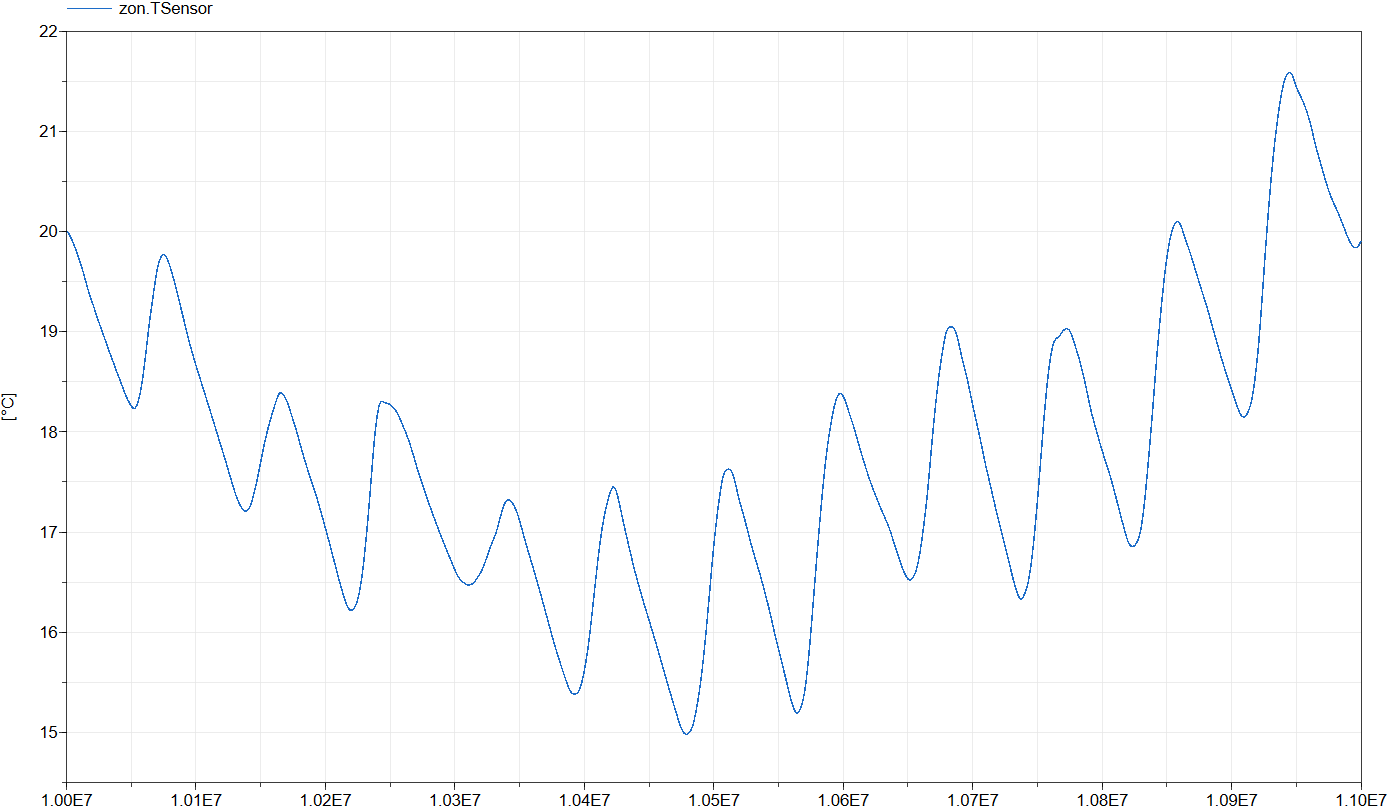
This model is simulated with the following settings:
The simulation starts 107 seconds after New Year and
ends 106 seconds later, covering a period of 11.6 days.
The figure below shows the operative zone temperature,
zon.TSensor, which represents the mean of the air
temperature and the mean radiative temperature of all surfaces.
| Name | Description |
|---|---|
| MediumAir | Air medium |