 .Modelica_DeviceDrivers.Blocks.Packaging.SerialPackager.PackUnsignedInteger .Modelica_DeviceDrivers.Blocks.Packaging.SerialPackager.PackUnsignedInteger
The block allows to pack unsigned integer values on bit level.
The number of bits used for encoding is set by parameter
width, therefore the maximum value of the integer
signal that can be encoded is 2^width - 1. The
parameter bitOffset allows to specify the bit at which
the encoding starts relative to the preceding block.
If an AddBoolean, AddInteger,
AddReal or AddString block follows a
PackUnsignedInteger block the bit position after the
PackUnsignedInteger block is aligned to the next byte
boundary.
Currently, the pack block only supports Intel-Endianness (little-endian!).
For information about endianness in computing see for example http://en.wikipedia.org/wiki/Endianness
The block is used in example
TestSerialPackagerBitPack_UDP, depicted below.
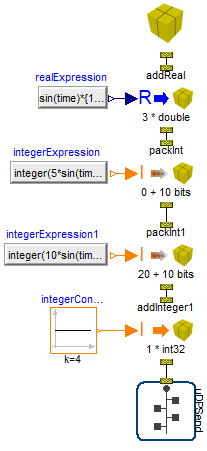
AddInteger block. Assuming that the value of the first
Integer variable was 3 (decimal) == 11 (binary) we
would get the memory layout below. A '.' denotes that the bit is
not part of the bits encoding the value (LSB = Least Significant
Byte and MSB = Most Significant Byte).
                                           byte 24                 byte 25
                                             LSB                      MSB
Relative bit position in Memory: (0  1  2  3  4  5  6  7)  (8  9  10 11 12 13 14 15) ( ..
Value of bit                   : (0  0  0  0  0  0  1  1)  (.  .   .  .  .  .  0  0)
See also
UnpackUnsignedInteger.