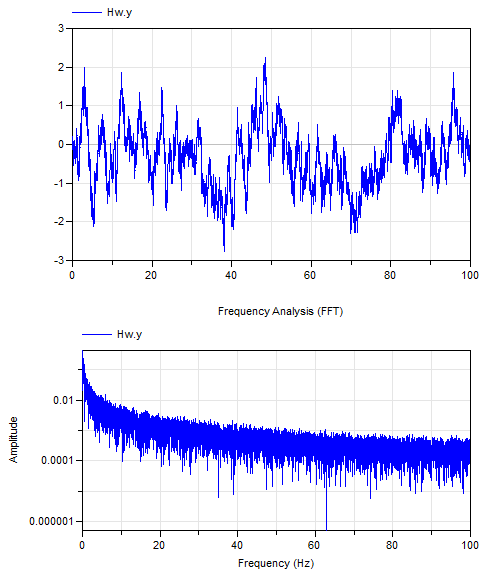
 .Modelica_Noise.Blocks.Examples.NoiseExamples.DrydenContinuousTurbulence .Modelica_Noise.Blocks.Examples.NoiseExamples.DrydenContinuousTurbulence
This example shows how to use the BandLimitedWhiteNoise to feed a Dryden continuous turbulence model. This model is used to describe turbulent wind at low altitudes that varies randomly in space (see also wikipedia).
The turbulence model of the Dryden form is defined by the power spectral density of the vertical turbulent velocity:
The spectrum is parametrized with the following parameters:
Using spectral factorization and a fixed airspeed V of the aircraft, a concrete forming filter for the vertical turbulence can be found as
,
for which V * (H_w(i Omega/V) * H_w(-i Omega/V) = Phi_w(Omega).
The input to the filter is white noise with a normal distribution, zero mean, and a power spectral density of 1. That means, for a sampling time of 1s, it is parameterized with mean=0 and variance=1. However, in order to account for the change of noise power due to sampling, the noise must be scaled with sqrt(samplePeriod). This is done automatically in the BandLimitedWhiteNoise block.