Paracetamol and it's metabolites.
In healthy adults, paracetamol is rapidly absorbed and widely
distributed with a volume of distribution approximating total body
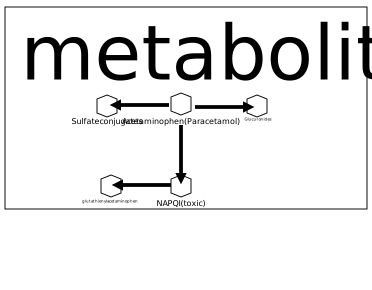
water, undergoing extensive hepatic metabolism primarily via
glucuronidation and sulfation pathways, with a minor fraction
oxidized by cytochrome P450 enzymes to form the toxic reactive
metabolite NAPQI, which is subsequently detoxified by glutathione
conjugation.
There are other metabolites observed in animal experiments,
but not found in humans, thus not present in model
implementation.
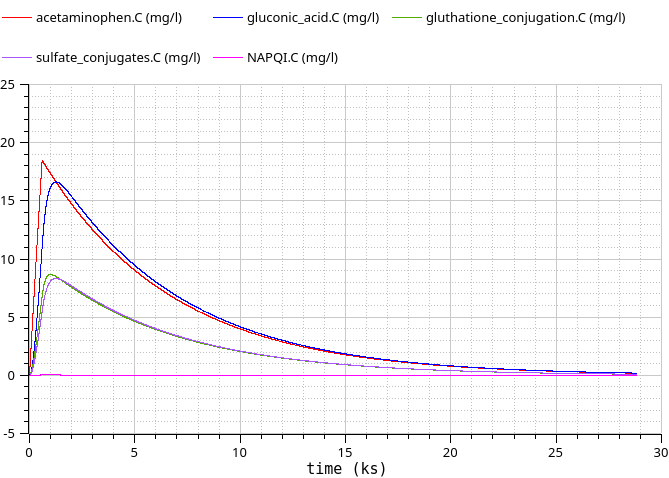
Simulation of paracetamol and it's metabolites pharmacokinetics 8h
after paracetamol administration.
References:
Prescott, L. F. "Kinetics and metabolism of paracetamol and
phenacetin." British
journal of clinical pharmacology 10.S2
(1980):
291S-298S. https://doi.org/10.1111/j.1365-2125.1980.tb01812.x
Zhao, Lizi, and
Gisèle Pickering. "Paracetamol metabolism and related genetic
differences." Drug metabolism
reviews 43.1
(2011):
41-52. https://doi.org/10.3109/03602532.2010.527984
Generated at 2026-04-15T18:18:36Z by OpenModelicaOpenModelica 1.26.3 using
GenerateDoc.mos
 .Pharmacolibrary.Drugs.N_NervousSystem.N02B_OtherAnalgesicsAndAntipyretics.N02BE01_Paracetamol.Paracetamol_metabolites