Fentanyl is a potent synthetic opioid used to manage
severe pain and as an anesthetic adjunct during surgery. After
intravenous administration, it rapidly distributes into highly
perfused organs—such as the brain, heart, lungs, and kidneys—while
also partitioning more slowly into
poorly perfused tissues like fat and muscle. Over time, both
tissue groups release fentanyl back into the plasma. The
pharmacokinetics of fentanyl can be captured by the
three-compartment model in this example, in which the “peripheral”
and “peripheral2” compartments represent highly and poorly perfused
tissues, respectively.
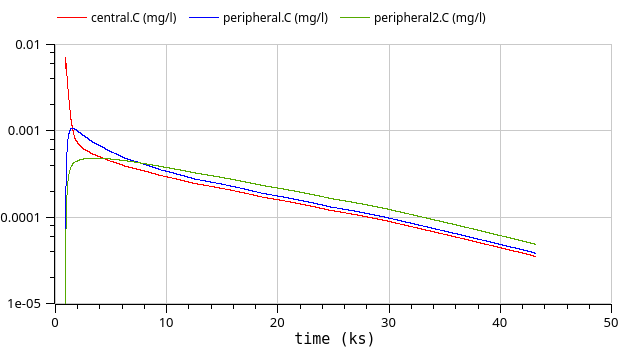
Simulation of 12h fentanyl pharmacokinetics in central,
highly perfused tissue (perihperal) and slowly perfused tissues
(fat, muscle). Concentration in compartments in log-scale.
References:
Kaneda, Kotaro and Tae-Hyung Han (2009-09). “Comparative
population pharmacokinetics of fentanyl using non-linear mixed
effect modeling: burns vs. non-burns”. en. In: Burns 35.6, pp.
790–797. ISSN: 0305-4179,1879-1409. DOI:
10.1016/j.burns.2008.12.006. URL:
http://dx.doi.org/10.1016/j.burns.2008.12.006
Generated at 2026-04-14T18:18:34Z by OpenModelicaOpenModelica 1.26.3 using
GenerateDoc.mos
 .Pharmacolibrary.Examples.PK_3C_FentanylIV