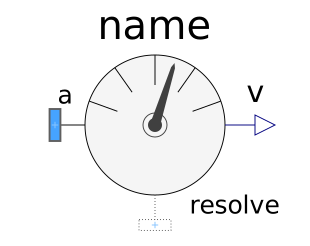
 .PlanarMechanics.Sensors.AbsoluteVelocity .PlanarMechanics.Sensors.AbsoluteVelocity
The absolute velocity vector of the origin of
frame_a is determined and provided at the output
signal connector v.
Via parameter resolveInFrame it is defined, in
which frame the velocity vector is resolved.
| resolveInFrame = … | Output vector resolved in |
|---|---|
| Types.ResolveInFrameA.world | world frame |
| Types.ResolveInFrameA.frame_a | frame_a |
| Types.ResolveInFrameA.frame_resolve | frame_resolve (must be connected) |
If resolveInFrame =
Types.ResolveInFrameA.frame_resolve, the conditional
connector frame_resolve is enabled
and v is resolved in the frame, to which
frame_resolve is connected. Note, if this connector is
enabled, it must be connected.
Example: If resolveInFrame =
Types.ResolveInFrameA.frame_resolve, the output vector is
computed as:
![v0 = der([x,y,phi])](PlanarMechanics%201.6.0/Resources/Images/equations/equation-x2brh9fX.png)
![v = [cos(frame_resolve.phi), sin(frame_resolve.phi),0;-sin(frame_resolve.phi),cos(frame_resolve.phi),0;0,0,1] * [v0[1];v0[2];v0[3]]](PlanarMechanics%201.6.0/Resources/Images/equations/equation-Kgd1NoyE.png)
where [x y φ] is
position and angle vector of origin of frame_a
resolved in world frame.
 Developed 2010 at the DLR Institute of System
Dynamics and Control
Developed 2010 at the DLR Institute of System
Dynamics and Control