 .TAeZoSysPro.FluidDynamics.BasesClasses.FreeAeraulicConvection .TAeZoSysPro.FluidDynamics.BasesClasses.FreeAeraulicConvection
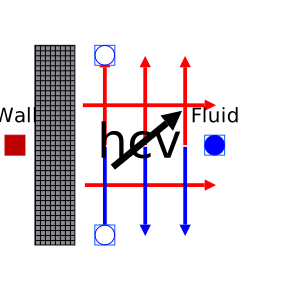
This components allows to model the air movement induced by natural convection over a vertical wall. It assumes that the prerequisites presented in the information tab of the FreeConvection of the HeatTransfer component are known.
To quantify the convective flow of gas an analogy between heat and mass transfer is made. The natural convection heat transfer coefficient encompasses the balance between the buoyancy force and the viscous force. This is a globalisation of the local resolution of momentum and energy conservation. Therefore, it is supposed that all the heat dissipated by the wall creates the work to make the gas move. To computed the mass flow rate inducted bu natural convection, it is necessary to make closure hypotheses. Indeed, the mathematical model under the analogy presented above gives:

Where:
m_flow is the mass flow rate induced by
convectioncp is the specific heat capacity at constant
pressure of the mixtureT_outlet is the mean outlet Temperature of the
boundary layerT_inlet is the mean inlet Temperature of the
boundary layerh_cv is the convective heat transfer
coefficientS is exchange surface areaT_wall is the wall TemperatureT_∞ is fluid Temperature outside the boundary
layerThe unknown variables are m_flow,
T_outlet and T_inlet. With this tree
unknowns and one equation, two closure equations are
required.
The obvious comes with the inlet temperature which is equal to
the T_∞ because there is there is not yet a boundary
layer.
The second is to assume that T_outlet =
T_wall. In pratical is never true. A Computationnal
Fluid Dynamic (CFD) study performed on a flat plate in a rest
atmosphere gives roughly a flow rate twice that calculated from the
method above.
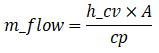
The final expression for the mass flow rate derives:
All the flowports have to be connected to components of type control volume (lump volume, boundaries...).
| Name | Description |
|---|---|
 Medium Medium |