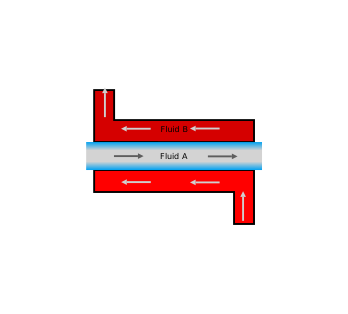
 .TAeZoSysPro.HeatTransfer.BasesClasses.PartialHeatExchanger .TAeZoSysPro.HeatTransfer.BasesClasses.PartialHeatExchanger
This components contains partial equation describing a generic adiabatic heat exchanger using the effetiveness method. The advantage of the effetiveness method regarding the mean logarithmic method is to avoid a non linear equation where oulet temperature are unknown(see explainations in the theoretical note). The system of equations describing an heat exchanger derives:
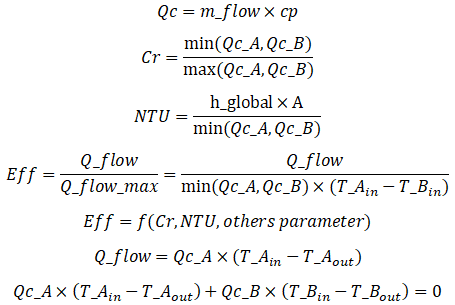
Where:
An heat exchanger is a complex object that can have various configurations such as:
Therefore, it has been chosen to develop a partial heat exchanger containing the common equations to all kind of exchanger whatever its configuration. For a specific exchanger the user just have to inherit this partial model and give the specific missing equations for: