Partial model of quasi-stationary mass and heat transfer
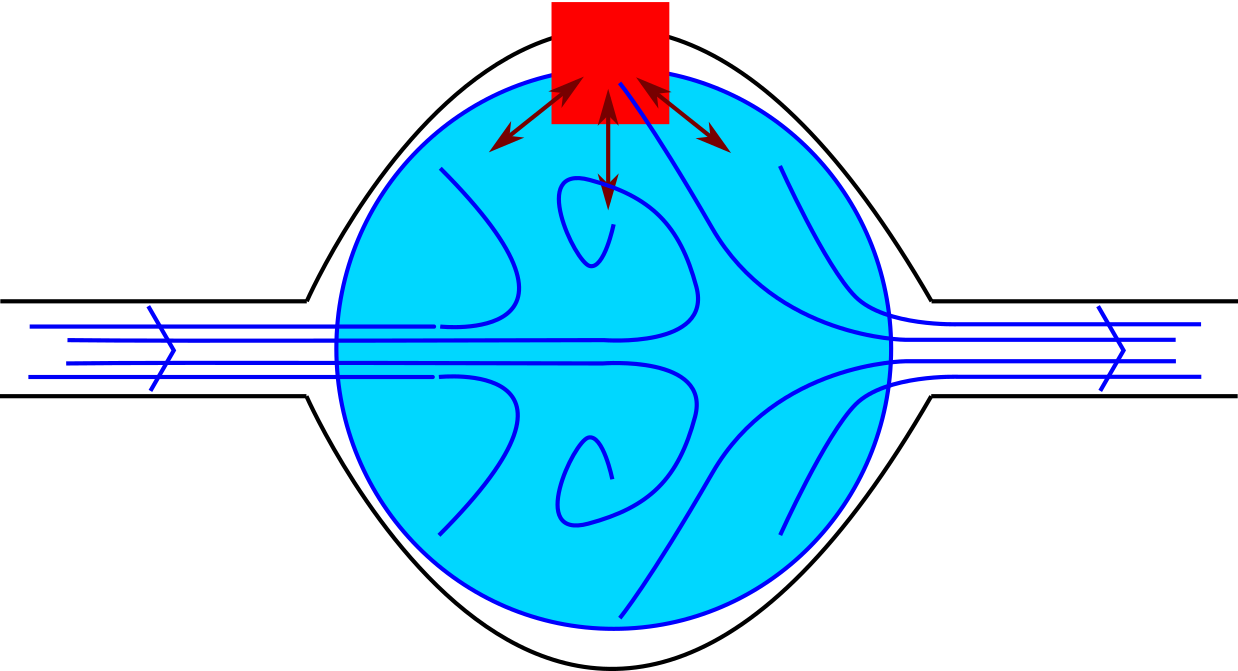
This model is an element with a fixed volume (fig. 1). The mass
in the volume is assumed quasi-stationary (statically computed with
volume and density), and the fore massflow is coupled to the rear
massflow. Because of this the ConductionElement cannot be
used as a loop breaker. The advantage is that multiple
ConductionElements can be put behind each other without worrying
about oscillations or fast eigenvalues between their masses. The
ConductionElement implements equations for conservation of mass and
energy for the fluid mass contained within it.
Initialization can be done by initial temperature, initial
enthalpy or by using the inlet state.
The ConductionElement makes different assumptions:
- Quasistationary mass:
m_flow_rear = - m_flow_fore & M = rho * V (this assumption
violates the conservation of mass for changing densities, since the
mass in the element can change although inflow and outflow are the
same)
der(H) = der(M*h) = M*der(h) (This assumption violates the
conservation of energy for changing densities, since then the mass
M of fluid in the element is no longer constant)
- Neglection of der(p) in the energy equation
V*der(p) = 0 (this assumption violates the conservation of energy
for changing pressures. For a noticeable difference in the testcase
the der(p) must be in the order of 1e5 Pa/s).
This assumption can be turned off by setting
neglectPressureChanges=false (true by default) in the Advanced tab.
This option requires the fore and rear input pressures to
be smooth.
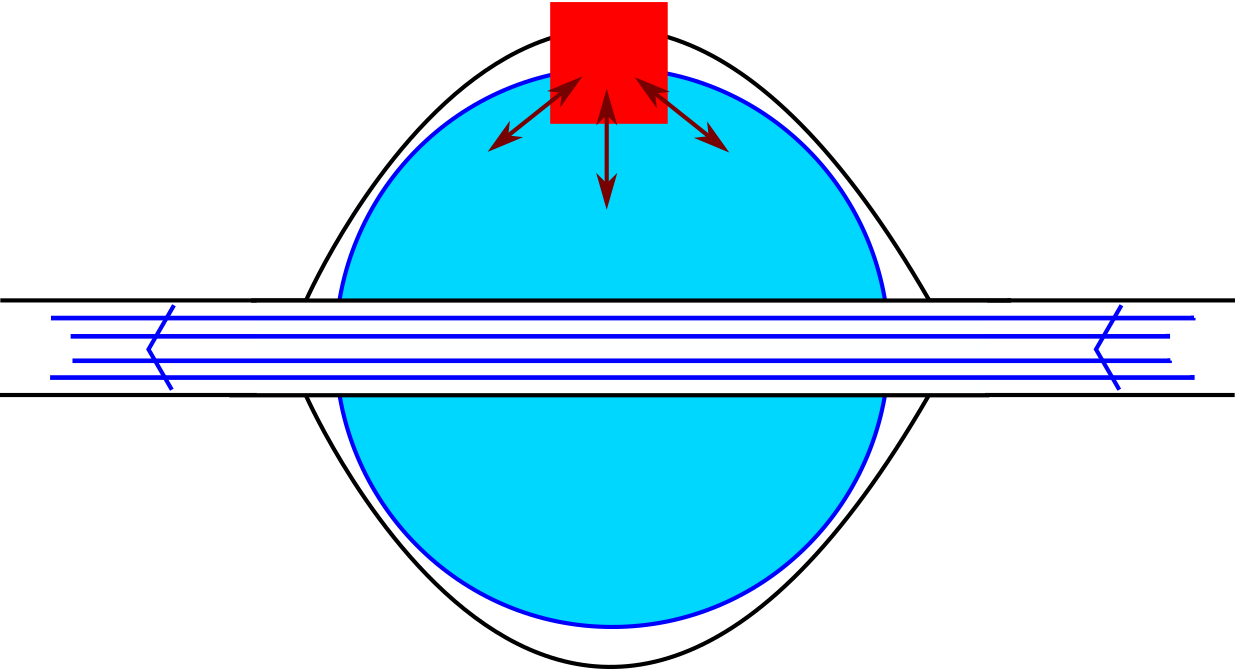
- Due to stability reasons the component exhibits a different
behavior for negative massflows (see fig. 2). For negative
massflows, the ingoing and outgoing massflows get decoupled from
the fluid remaining in the component. The fluid exits with the same
state as it enters, and the heatport is connected to the fluid left
in the volume (which is decoupled to the mass flowing).
Due to these assumptions minor violations in the global energy
conservation can occur. With the flag
enforce_global_energy_conservation in the "Advanced" tab is set
true (Default: false), long-term energy storage in the
ConductionElement is sacrificed to hold global energy
conservation.
fig. 1: positive massflow model
fig. 2: negative massflow model
Generated at 2026-04-15T18:18:36Z by OpenModelicaOpenModelica 1.26.3 using
GenerateDoc.mos
 .ThermofluidStream.Processes.Internal.PartialConductionElement