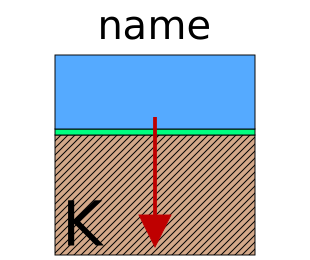
 .Buildings.BoundaryConditions.GroundTemperature.UndisturbedSoilTemperature .Buildings.BoundaryConditions.GroundTemperature.UndisturbedSoilTemperature
This model provides a prescribed temperature boundary condition for buried objects, where the temperature is computed per the ASCE (1996) equation:

where:
Ts,z = ground temperature at depth
z,
τ = annual period length (constant 365.25 days),
α = soil thermal diffusivity (assumed constant throughout
the year),
t = time,
Tms = mean annual surface temperature,
As = temperature amplitude throughout the year
(max - min),
tlag = phase lag of the surface temperature
sinusoid
Without correction, this model assumes that the surface
temperature (depth = 0) is equal to the air temperature, which is
acceptable for most design calculations.
For more accurate calculation, this model provides methods to
compensate for the convective thermal resistance and the impact of
surface cover.
The convective thermal resistance can be modeled as a virtual
equivalent soil layer by setting the flag useCon to
true and specifying the heat transfer coefficient
hSur.
This correction would result in a larger delay and dampening of the
resulting sinusoid.
The impact of surface cover on soil temperature can be modeled
using n-factors by setting the flag useNFac to
true and specifying the thawing and freezing
n-factors at the surface.
More information about n-factors correction can be found in
the documentation for
Buildings.BoundaryConditions.GroundTemperature.BaseClasses.surfaceTemperature.
Since n-factors incorporate the effect of surface
convection, both corrections would typically not be applied
simultaneously.
ASCE (1996). Cold Regions Utilities Monograph. D.W. Smith, Technical Editor.