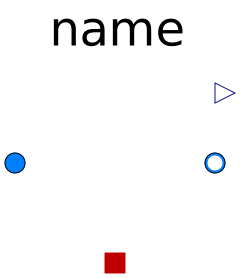
 .Buildings.DHC.BaseClasses.Steam.PartialSaturatedControlVolume .Buildings.DHC.BaseClasses.Steam.PartialSaturatedControlVolume
This model represents a partial control volume for either
condensation or evaporation processes of water with liquid and
vapor phases in equilibrium and at a saturated state. Models that
extend this base class need to assign the mass flow rate at each
port and the enthlapy at each port, as exemplifed in the
evaporation and condensation models listed below. The volume can
exchange heat through its heatPort when configured
with dynamic mass and energy balances. In steady state, the heat
port is conditionally removed in order to maintain a consistent set
of equations.
This model is similar to Modelica.Fluid.Examples.DrumBoiler.BaseClasses.EquilibriumDrumBoiler with the following exceptions:
(port_a), and steam vapor at the downstream port
(port_b) for instances of this base class that model
evaporation (the opposite for condensation);This model is configured to allow both steady state and dynamic
mass and energy balances. The heat transfer through the
heatPort is disabled in steady state balance. This is
required because the fluid is restricted to a saturated state;
thus, the heat transfer rate is a function of mass flow rate only
if the volume is steady. The fluid mass m in the volume is
calculated as
m = ρsVs + ρwVw
where ρ is density,V is volume, and subscripts represent the steam and liquid water components, respectively. The total internal energy U is
U = ρsVshs + ρwVw − pV
where h is specific enthalpy, p is pressure, and the total volume of fluid V=Vs+Vw.
The steady state mass balance is given as
ṁs + ṁw = 0,
while no additional equation is given for the steady state energy balance, since the heat flow rate into the water must be removed from the system in which the control volume is used.
The dynamic mass and energy balances are given as
dm/dt = ṁs
+ ṁw
dU/dt = Q̇ + ṁs hs + ṁ w
hw
where ̇ṁs and ṁw are the
mass flow rates of steam and liquid water respectively; Q̇
is the heat flow rate into the control volume; hs
and hw are the specific enthalpies of steam and
liquid water, respectively. Note that with an evaporation process,
the liquid phase (water) is always assigned at the
port_a (inlet), while the vapor phase (steam) is
always at the port_b (outlet). The opposite holds for
a condensation process.
Three principal assumptions are made with this model:
Models that extend this base class include Buildings.DHC.Plants.Steam.BaseClasses.ControlVolumeEvaporation and Buildings.DHC.Loads.Steam.BaseClasses.ControlVolumeCondensation.
Hinkelman, Kathryn, Saranya Anbarasu, Michael Wetter, Antoine Gautier, and Wangda Zuo. 2022. “A Fast and Accurate Modeling Approach for Water and Steam Thermodynamics with Practical Applications in District Heating System Simulation.” Preprint. February 24. doi:10.13140/RG.2.2.20710.29762.
| Name | Description |
|---|---|
 MediumWat MediumWat |
Liquid water medium |
 MediumSte MediumSte |
Steam medium |