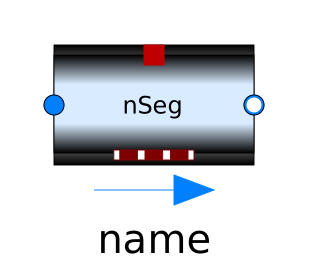
 .Buildings.Fluid.FixedResistances.Pipe .Buildings.Fluid.FixedResistances.Pipe
Model of a pipe with flow resistance and optional heat exchange with environment.
There are two possible configurations:
useMultipleHeatPorts=false (default option),
the pipe uses a single heat port for the heat exchange with the
environment. Note that if the heat port is unconnected, then all
volumes are still connected through the heat conduction elements
conPipWal. Therefore, they exchange a small amount of
heat, which is not physical. To avoid this, set
useMultipleHeatPorts=true.useMultipleHeatPorts=true, then one heat port
for each segment of the pipe is used for the heat exchange with the
environment. If the heat port is unconnected, then the pipe has no
heat loss.The default value for the parameter diameter is
computed such that the flow velocity is equal to
v_nominal=0.15 for a mass flow rate of
m_flow_nominal. Both parameters, diameter
and v_nominal, can be overwritten by the user. The
default value for dp_nominal is two times the pressure
drop that the pipe would have if it were straight with no fittings.
The factor of two that takes into account the pressure loss of
fittings can be overwritten. These fittings could also be
explicitly modeled outside of this component using models from the
package Modelica.Fluid.Fittings.
For mass flow rates other than m_flow_nominal, the
model Buildings.Fluid.FixedResistances.PressureDrop
is used to compute the pressure drop.
For a steady-state model of a flow resistance, use Buildings.Fluid.FixedResistances.PressureDrop instead of this model.
res to preDro for #292.nominal with default values as
they are computed using the default Medium values.useMultipleHeatPort to
useMultipleHeatPorts and used heat port connector from
Modelica.Fluid package for vector of heat ports.