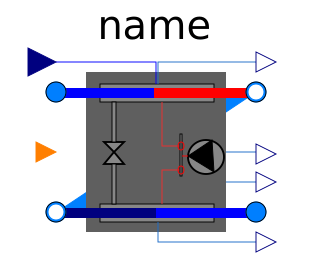
 .Buildings.Fluid.HeatPumps.EquationFitReversible .Buildings.Fluid.HeatPumps.EquationFitReversible
Model for a reversable heat pump using the equation fit method and that takes as an input the set point for the leaving fluid temperature.
This reversable heat pump can be operated either in heating mode
or in cooling mode. It typically is used for a water to water heat
pump, but if the performance data per are set up for
other media, such as glycol, it can also be used for such
applications. Note that if used with air, the results will only be
valid if there is no humidity condensation or frost build up. The
heat exchanger at medium 1 is to be connected to the building load,
and the other heat exchanger to the heat source or sink, such as a
geothermal loop. If in heating mode, the heat exchanger at medium 1
operates as a condenser, and in cooling mode it operates as an
evaporator.
The model is based on the model described in the EnergyPlus 9.1.0 Engineering Reference, Section 16.6.1: Water to water heat pump model and the model based on C.Tang (2005).
The model takes the following control signals:
uMod which controls the heat
pump operational mode. If per.reverseCycle = true the
signal can take on the values -1 for cooling mode, 0
for off and +1 for heating mode.per.reverseCycle = false and uMod =
-1, the model stops with an error message.TSet is the set point for the leaving
fluid temperature at port port_b1.The heating and cooling performance coefficients are stored in
the data record per and are available from Buildings.Fluid.HeatPumps.Data.EquationFitReversible.
The electric power only includes the power for the compressor, but not any power for pumps, as the pumps must be modeled outside of this component.
The performance of the heat pump is computed as follows: Let
α be the set of heat load performance coefficients
determined by the data record per.hea.coeQ and let
β be the set of electrical power performance coefficients
determined by the data record hea.coeP. Then, the
performance is computed as
uMod = 1, the heat pump is in heating mode and
the load side available heat is
Q̇ava = ( α1 + α2 Tloa,ent/TRefHeaLoa + α3 Tsou,ent/TRefHeaSou + α4 ṁloa,ent/(ṁloa,0 s) + α5 ṁsou,ent/(ṁsou,0 s) ) Q̇0 s,
where Q̇0 is the design capacity as specified
by the parameter per.hea.Q_flow and s is the
scaling factor specified by the parameter
scaling_factor. The corresponding power consumption
is
P= ( β1 + β2 Tloa,ent/TRefHeaLoa + β3 Tsou,ent/TRefHeaSou + β4 ṁloa,ent/(ṁloa,0 s) + β5 ṁsou,ent/(ṁsou,0 s) ) P0 s,
where P0 is the design power consumption as
specified by the parameter per.hea.P. The actual heat
provided at the load side is
Q̇ = min(Q̇ava , Q̇set),
where Q̇set is the heat required to meet the temperature setpoint for the leaving fluid on the load side.
uMod =
-1
, the heat pump is in cooling mode,
and the governing equations are as above, but with
per.coo rather than per.hea used for the
performance data, and the min(· ·) function replaced with
max(· ·).uMod = 0, the model sets Q̇ = 0 and P
= 0.The coefficient of performance COP is computed as
COP = Q̇ ⁄ P.
C. Tang Equation fit based models of water source heat pumps. Master Thesis. Oklahoma State University, Oklahoma, USA. 2005.