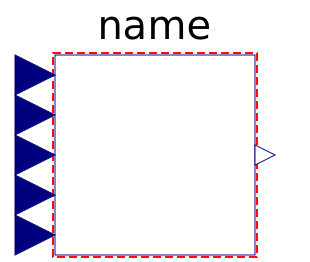
 .Buildings.Obsolete.Fluid.SolarCollectors.BaseClasses.EN12975SolarGain .Buildings.Obsolete.Fluid.SolarCollectors.BaseClasses.EN12975SolarGain
This component computes the solar heat gain of the solar thermal collector. It only calculates the solar heat gain without considering the heat loss to the environment. This model performs calculations using ratings data from EN12975. The solar heat gain is calculated using Equation 559 in the referenced EnergyPlus documentation. The calculation is modified somewhat to use coefficients from EN12975.
The equation used to calculate solar gain is a modified version of Eq 559 from the EnergyPlus documentation. It is
QFlow[i] = Ac/nSeg FR(τα) (K (τα),Beam GBeam (1-shaCoe)+KDiff G Diff),
where QFlow[i] is the heat gained in each
segment, A c is the area of the collector,
nSeg is the number of segments in the collector,
FR(τα) is the maximum efficiency of the
collector, K(τα),Beam is the incidence angle
modifier for beam radiation, GBeam is the current
beam radiation on the collector, shaCoe is the shading
coefficient, KDiff is the incidence angle
modifier for diffuse radiation and GDiff is the
diffuse radiation striking the surface.
The solar radiation equation indicates that the collector is
divided into multiple segments. The number of segments used in the
simulation is specified using the parameter nSeg. The
area of an individual segment is identified by dividing the
collector area by the total number of segments. The parameter
shaCoe is used to define the percentage of the
collector which is shaded. The main difference between this model
and the ASHRAE model is the handling of diffuse radiation. The
ASHRAE model contains calculated incidence angle modifiers for both
sky and ground diffuse radiation while this model uses a
coefficient from test data for diffuse radiation.
The incidence angle modifier for beam radiation is calculated using Eq 555 from the EnergyPlus documentation, as
K(τα),Beam=1+b0 (1/cos(θ)-1)+b1 (1/cos(θ)-1)2,
where K(τα),Beam is the incidence angle modifier for beam radiation, b0 is the first incidence angle modifier coefficient, θ is the incidence angle and b1 is the second incidence angle modifier coefficient.
This model reduces the heat gain rate to 0 W when the fluid temperature is within 1 degree C of the maximum temperature of the medium model. The calculation is performed using the Buildings.Utilities.Math.Functions.smoothHeaviside function.
EnergyPlus 7.0.0 Engineering
Reference, October 13, 2011.
CEN 2006, European Standard 12975-1:2006, European Committee for
Standardization
| Name | Description |
|---|---|
 Medium Medium |
Medium in the system |
Obsolete package.each.displayUnit.Temperature to
ThermodynamicTemperature to avoid an error in the
pedantic model check in Dymola 2017 FD01 beta2.Medium.T_max
to make it more efficient.