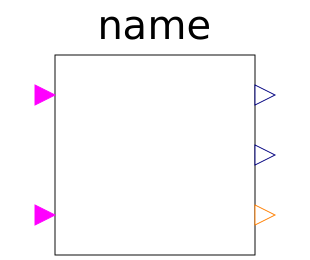
 .Buildings.Templates.Plants.Controls.StagingRotation.SortRuntime .Buildings.Templates.Plants.Controls.StagingRotation.SortRuntime
This block implements the rotation logic for identical parallel staged equipment that are lead/lag alternated.
Two runtime points are defined for each equipment. The Lifetime Runtime is the cumulative runtime of the equipment since equipment start-up. This point is not readily resettable by operators. Lifetime Runtime should be stored to a software point on the control system server so the recorded value is not lost due to controller reset, loss of power, programming file update, etc. The Staging Runtime is an operator resettable runtime point that stores cumulative runtime since the last operator reset.
In the case of available equipment, when more than one equipment is off or more than one is on, the equipment with the most operating hours as determined by Staging Runtime is made the last stage equipment and the one with the least number of hours is made the lead stage equipment.
In the case of unavailable equipment, the equipment that alarmed most recently is sent to the last position. The equipment in alarm automatically moves up in the staging order only if another equipment goes into alarm.
When the controller is initialized, the choice of the first
equipment to run is random since all runtimes are equal to zero.
So, before this first equipment reports status, all equipment will
be considered off and only this first equipment will increase
runtime and be queued in the staging order. At next stage change,
another equipment will then be staged on instead, resulting in the
first running equipment being "hot swapped". To avoid this
behavior, the vector parameter runTim_start is used to
initialize the staging runtime, which will be fixed at this
parameter value until it becomes higher. The parameter
runTim_start should be set to a vector of strictly
increasing values, where the minimum value is greater than the time
needed for the equipment to report status.
The sorting logic is implemented using the following method.
This is effectively the same as sorting the units within the
three following subsets: units that are on and available, units
that are off and available, units that are unavailable. In
particular, the order index of a given unit remains unchanged if it
is the only element of a given subset. Note that the staging
runtime and the time elapsed since an equipment became unavailable
are both computed from Boolean signals (u1Run and
u1Ava). These are discrete-time, piecewise constant
variables, which is why the caveat in the documentation of Buildings.Controls.OBC.CDL.Reals.Sort
for purely continuous time-varying variables does not apply here.
Therefore, no sampling is performed before sorting the equipment
runtimes.
To facilitate integration into the plant controller, the input vectors cover the full set of equipment, including equipment that may not be lead/lag alternate. The output vectors cover only the subset of lead/lag alternate equipment, and the vector of sorted equipment provides indices with respect to the input vectors (full set of equipment).