 .BusinessSimulation.Examples.LotkaVolterraEquationsRevisited .BusinessSimulation.Examples.LotkaVolterraEquationsRevisited
This information is part of the Business Simulation Library (BSL). Please support this work and ► donate.
This model extends the two species model given in the example →LotkaVolterraSystems by introducing a third species: wolves. Wolves predate on both, rabbits and foxes.
We can immediately extend the model for two species by
introducing another material stock for wolves. As predators
wolves will also be connected to a process of
exponential decline (e.g., starvation in absence of prey).
Since wolves predate on rabbits and
foxes, there will be two nonlinear interactions
between the stock of wolves and the other stocks. As
before, the predator side (portB) of the
NonlinearInteraction flow will be connected to the
inflow port for wolves, while the prey
side (portA) will be connected to the
outflow port of rabbits and
foxes.
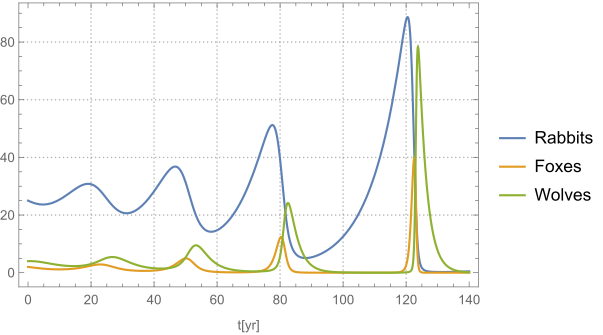 |
init = InitializationOptions.SteadyState
in the Advanced tab for modelSettings allows
us to find the equilibrium levels for the three populations.model to collect
global parameters: theta. Doing so is quite convenient
for more complex models (where we will often choose to additionally
assign the inner prefix), as we can set up the model
as a component of its own and then simply modify an instance of it
to arrive at a scenario run.theta in the diagram we can
then set all parameters in the General or in the
Parameters tab in SystemModeler.The model presented here comes from Michael Tiller's excellent introduction "Modelica by Example" (see Object-Oriented Modeling>Components>Examples>Lotka-Volterra Equations Revisited), which ships with SystemModeler and can also be found online.
LotkaVolterraSystems, Tutorial.UnitsInBusinessSimulations
| Name | Description |
|---|---|
 ModelOutput ModelOutput |
Main output of the model |
 Theta Theta |
Parameter definitions for the Base Case |