After differentiating and doing some algebra, one arrives at
the following DE:
d2theta/dt2 + (mgL/I) sin(theta) =
0
The period can be found by integrating the dt/dtheta
expression above, performing a change of integration variable, and
using a trig half-angle formula. The result is a complete elliptic
integral, K(k):
T = 4 sqrt(I/mgL) K(sin(theta0/2))
Plotting the period, T, as a function of starting angle
(assuming dtheta/dt=0 at theta0):
Near theta0=0, one finds the solution
(T0~2s) for the small-angle approximation: sin(theta) ~
theta.
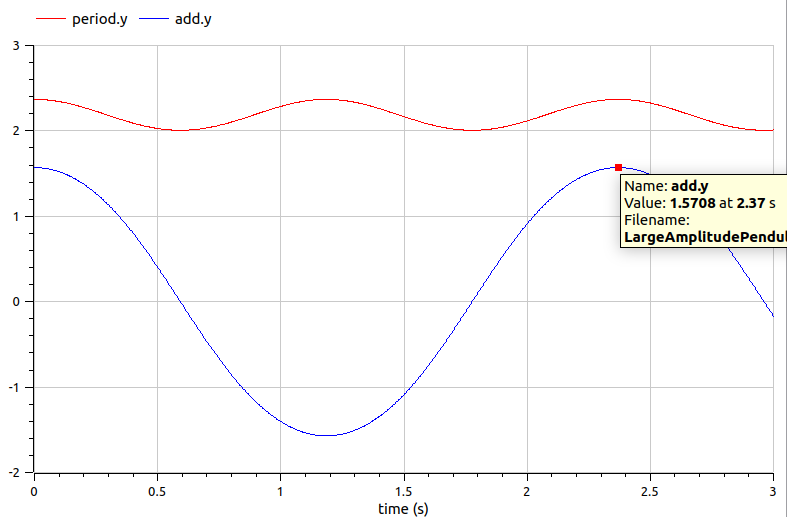
The period of the swinging-body simulation is found to match
the calculation of the period from the max angle:
Keep in mind that this acts as a check for the former, not the
latter.
 .GNU_ScientificLibrary.Examples.specfunc.LargeAmplitudePendulum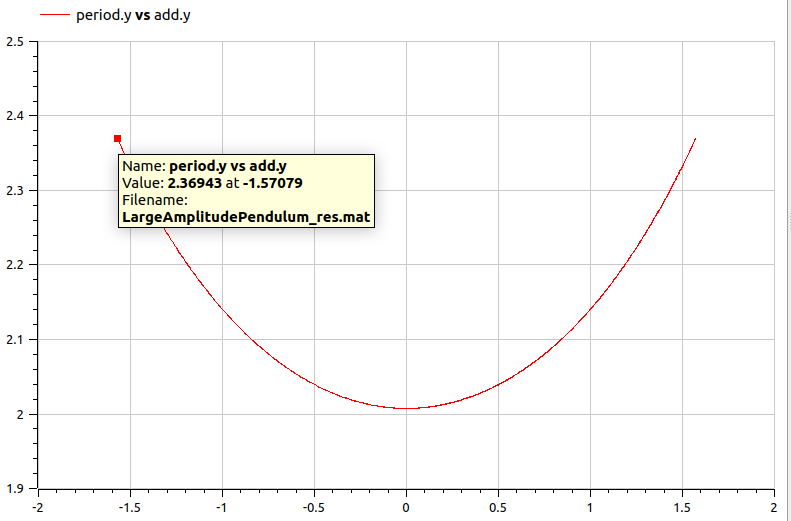
 BodyParams