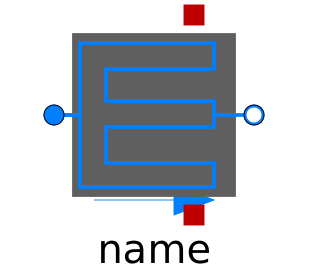
 .Buildings.Fluid.HeatExchangers.RadiantSlabs.ParallelCircuitsSlab .Buildings.Fluid.HeatExchangers.RadiantSlabs.ParallelCircuitsSlab
This is a model of a radiant slab with pipes or a capillary heat exchanger embedded in the construction. The model is a composition of multiple models of Buildings.Fluid.HeatExchangers.RadiantSlabs.SingleCircuitSlab that are arranged in a parallel.
The parameter nCir declares the number of parallel
flow circuits. Each circuit will have the same mass flow rate, and
it is exposed to the same port variables for the heat port at the
two surfaces, and for the flow inlet and outlet.
A typical model application is as follows: Suppose a large room has a radiant slab with two parallel circuits with the same pipe spacing and pipe length. Then, rather than using two instances of Buildings.Fluid.HeatExchangers.RadiantSlabs.SingleCircuitSlab, this system can be modeled using one instance of this model in order to reduce computing effort. See Buildings.Fluid.HeatExchangers.RadiantSlabs.Examples.SingleCircuitMultipleCircuitEpsilonNTU for an example that shows that the models give identical results.
Since this model is a parallel arrangment of nCir
models of
Buildings.Fluid.HeatExchangers.RadiantSlabs.SingleCircuitSlab,
we refer to
Buildings.Fluid.HeatExchangers.RadiantSlabs.SingleCircuitSlab
for the model documentation.
See the user's guide for more information.
To allow a better comment for the nominal mass flow rate, i.e., to specify that its value is for all circuits combined, this model does not inherit Buildings.Fluid.Interfaces.PartialTwoPortInterface.
homotopyInitialization to a constant.noEvent to the computation of the states at the
port. This is correct, because the states are only used for
reporting, but not to compute any other variable. Use of the states
to compute other variables would violate the Modelica language, as
conditionally removed variables must not be used in any
equation.show_V_flow.port_a and port_b, which used
Medium.p_default instead of the parameter
p_start.