General
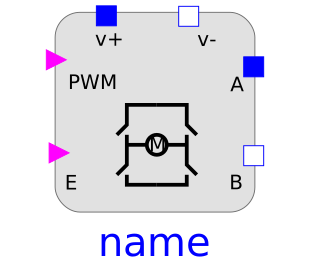
This component simulates the behaviour of an h-bridge using
MOSFET transistors.
Implementation
This model has 4 transistors Q1, Q2, Q3 and Q4 wich their
respective diode. Q1 and Q4 form half bridge and Q2 and Q3 the
other half bridge.
Q1 and Q3 are PMOS transistors while Q2 and Q4 are NMOS given the
configuration.
The bridge is controlled using a Sign-Magnitude
drive with boolean inputs and outputs.
Notes
- The voltage should be applied on the electrical interfaces
(Vpos and Vneg) using an external dc source for example DCSource
.
- It uses the Sign-Magnitude method to control the signal
SignMagnitudDrive
.
- The motor pins should be connected to the MotorA and MotorB
pins.
- The inputs are the logical inputs PWM and ENABLE (or
direction), which can be generated by an external element, for
example Controller
.
- This model has a voltage sensor (real value) between MotorA and
MotorB pins and
- The transconductance of transistors can be change.
See also
Servomechanisms.Electrical.IdealHBridge
Generated at 2026-04-14T18:18:34Z by OpenModelicaOpenModelica 1.26.3 using
GenerateDoc.mos
 .Servomechanisms.Electrical.HBridge