Ideal H-Bridge
General
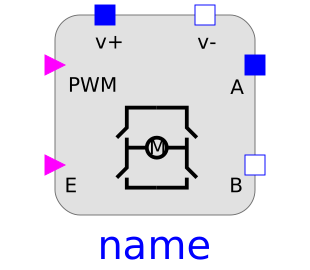
This component simulates the behaviour of an h-bridge using
ideal switches.
Implementation
This model has 4 ideal switches Q1, Q2, Q3 and Q4 wich their
respective diode. Q1 and Q4 form half bridge and Q2 and Q3 the
other half bridge.
The bridge is controlled using a Sign-Magnitude
drive with boolean inputs and outputs.
Notes
- The voltage should be applied on the electrical interfaces
(Vpos and Vneg) using an external dc source for example DCSource
.
- It uses the Sign-Magnitude method to control the signal
SignMagnitudDrive
.
- The motor pins should be connected to the MotorA and MotorB
pins.
- The inputs are the logical inputs PWM and ENABLE (or
direction), which can be generated by an external element, for
example Controller
.
- This model has a voltage sensor (real value) between MotorA and
MotorB pins and
- Ron (switch resistance when ON) and Goff (swithch conductance
when OFF) can be zero.
See also
Servomechanisms.Electrical.HBridge
Generated at 2026-04-14T18:18:34Z by OpenModelicaOpenModelica 1.26.3 using
GenerateDoc.mos
 .Servomechanisms.Electrical.IdealHBridge